
Supply planning: what it is and how to optimize supply planning
Cymara ·
What is a supply planning framework?
A supply planning framework turns expected demand into a feasible replenishment or production plan. It combines demand forecasts, current inventory, supplier or production capacity, lead times, safety stock and business constraints. A strong process then reviews exceptions and trade-offs regularly so purchasing and operations can protect service levels without building unnecessary inventory.
S&OP KPIs and process · MRP and purchasing · Demand forecasting software
Supply planning is the process of turning forecasted demand into a feasible plan for supply, production, inventory and procurement. Its goal is to ensure a company can deliver the right products, at the right time and at the lowest possible cost, while considering capacity, suppliers, materials, lead times, operational constraints and service levels.
In a business environment shaped by demand volatility, margin pressure and increasingly complex supply chains, planning is no longer just about calculating how much stock to buy. Companies need to anticipate scenarios, coordinate internal teams, reduce risk and make fast decisions based on reliable data.
This is where supply planning becomes a strategic capability. Effective supply planning connects commercial forecasts with operational reality: production capacity, material availability, lead times, inventory, suppliers, logistics costs and customer commitments.
When this connection fails, familiar problems appear: stockouts, excess inventory, urgent purchasing, cost overruns, delays, poor visibility and reactive decision making. When it works well, the company gains control, resilience and a stronger ability to respond to the market.
What is supply planning
Supply planning is the process by which a company determines how it will meet future demand with available resources. It usually starts from a demand forecast and turns it into an operational plan: what to produce, what to buy, where to place inventory, when to trigger orders and how to prioritise limited resources.
It is not just about ensuring product availability. It also means balancing multiple variables that often conflict: service level, cost, capacity, inventory, lead times, profitability and risk.
An effective supply plan answers questions such as:
- Which products must be available
- In what quantities
- In which locations
- At what time
- Through which suppliers or plants
- Under which capacity constraints
- With what financial impact
- With what level of risk
That is why supply planning should be understood as a decision-making system, not an isolated operational task. Its value lies in turning scattered information into coordinated decisions.
What decisions does a supply plan cover
A supply plan can include decisions related to purchasing, production, distribution, inventory and resource allocation. In manufacturing companies it may define which lines will produce specific products, in which sequence and with which raw materials available. In distribution businesses it may determine purchase quantities, stock allocation across warehouses and order prioritisation.
It may also include alternative sourcing decisions when a supplier fails, changes in production calendars, safety stock adjustments or simulations for demand peaks.
The key is that the plan must not be purely theoretical. It must be feasible. A forecast may indicate that 10,000 units will be sold, but supply planning must answer whether the company can buy, produce, store, transport and deliver them within the expected time frame.
Supply planning is not just inventory planning
Although inventory is a central element, reducing supply planning to "stock management" limits its impact. Inventory is the result of many previous decisions: demand forecasting, supply lead times, production capacity, commercial policy, supplier reliability and expected service levels.
A company may have enough inventory overall and still fail to serve customers properly if the stock is in the wrong location, if a critical component is missing or if logistics capacity is saturated.
That is why supply planning must analyse the complete system. It is not enough to have product available: the right product must be in the right place, at the right time and at a sustainable cost.
Supply planning, demand planning and supply chain planning: key differences
One of the most common mistakes is confusing supply planning with other planning processes. They are connected, but they are not the same.
| Process | Main focus | Question it answers |
|---|---|---|
| Demand planning | Demand forecasting | What will be sold? |
| Supply planning | Response capacity | How do we meet it? |
| Supply chain planning | End-to-end coordination | How does the full system fit? |
| S&OP | Commercial and operational alignment | Which plan do we agree on? |
| IBP | Financial and strategic view | Which plan is most profitable? |
Demand planning forecasts future demand using historical data, trends, seasonality, campaigns and market signals. Supply planning takes that forecast and analyses how to meet it: inventory, production, suppliers, purchasing, materials, transport and constraints. Supply chain planning coordinates planning across the entire chain. S&OP connects commercial and operational teams through recurring decision cycles, and IBP adds financial vision, profitability, scenarios and strategic goals.
What supply planning is used for
A strong supply planning process reduces improvisation. It helps anticipate constraints, prepare alternatives and make decisions before problems affect customers.
One of its most direct benefits is reducing stockouts. If the company identifies in advance where shortages may occur, it can accelerate purchases, reallocate inventory, change priorities or activate alternative suppliers.
It also helps avoid excess inventory. Buying or producing more than necessary ties up capital, takes up space, increases costs and can lead to obsolescence.
Another key benefit is improved service level: with visibility over demand, capacity and constraints, the company can commit to realistic dates, prioritise critical orders and reduce delays.
Supply planning also improves internal collaboration. Purchasing, operations, logistics, finance and sales stop working with different versions of reality and start deciding on a shared plan.
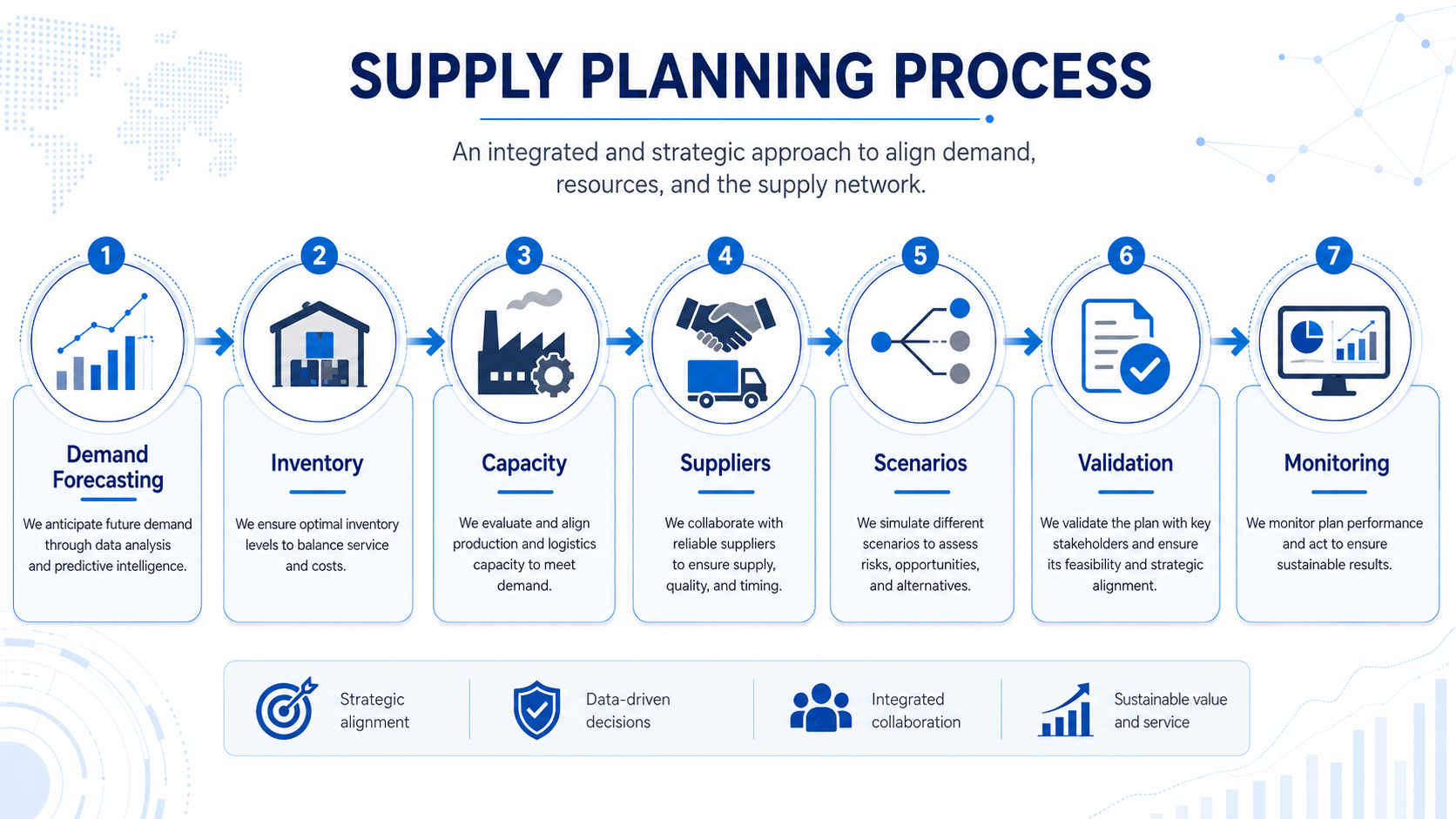
How the supply planning process works
The process starts with the demand forecast, which should be treated as a working hypothesis rather than an absolute truth.
Next, the company analyses available inventory, committed inventory, stock in transit and pending orders. This view shows the real supply position.
The next step is reviewing capacity: production lines, shifts, machinery, labour and component availability in manufacturing; warehouse space, transport, order preparation and delivery capacity in distribution.
Then suppliers, materials and lead times are evaluated. Not all suppliers have the same reliability and not all materials carry the same risk, so that variability must be built into the model.
With this information, scenarios are built. What happens if demand rises? What if a supplier is delayed? Which products should be prioritised if capacity is not enough? What is the impact of increasing safety stock or using urgent transport?
Finally, the plan is validated, published and monitored. Supply planning does not end when a report is generated: it must become continuous monitoring, exception management and learning.
What data good supply planning needs
The quality of the plan depends on the quality of the data. Without reliable data, planning becomes a mixture of intuition, urgency and spreadsheets that are hard to maintain.
- Demand: sales history, forecasts, open orders, campaigns, launches, promotions and seasonality.
- Inventory: available, blocked, in-transit and obsolete stock, locations, batches, expiry dates and coverage by product.
- Production and capacity: calendars, shifts, yields, changeover times, machine constraints and actual versus theoretical capacity.
- Suppliers: lead times, reliability, minimum order quantities, purchasing conditions, costs, incidents and alternative sources.
- Logistics and finance: transport costs, warehouse capacity, product margin, cost-to-serve and working capital targets.
The challenge is not just having data. It is connecting it and turning it into decisions.
Main supply planning challenges
One of the biggest challenges is working with unreliable forecasts. Demand changes, customers modify orders and markets react to external factors, so the plan must be flexible and reviewed frequently.
Another common challenge is departmental silos. Sales may prioritise availability, finance may push inventory reduction and operations may need production stability. Without a shared process, each area optimises its own goals and harms the overall result.
Variable lead times also make planning more complex: a supplier may promise four weeks and deliver in six.
Data quality is another critical point. Incomplete master data, poorly defined units, duplicate codes or outdated inventory generate incorrect plans. Add to that an excessive dependence on Excel, useful in early stages but fragile as SKUs, scenarios and constraints increase.
KPIs to measure supply planning
| KPI | What it measures | Why it matters |
|---|---|---|
| Service level | Demand fulfilled | Assess customer response |
| OTIF | On-time in-full deliveries | Measure real compliance |
| Stockouts | Product shortages | Detect availability failures |
| Excess inventory | Stock above what is needed | Control tied-up capital |
| Inventory turnover | Stock-to-sales efficiency | Optimise coverage |
| Coverage | Days or weeks of stock | Anticipate risk |
| Plan adherence | Plan execution rate | Detect unrealistic plans |
| Forecast accuracy | Forecast precision | Improve the plan input |
| Cost-to-serve | Cost per customer or channel | Decide with profitability |
Technology applied to supply planning
Technology can multiply planning capabilities, but only when supported by strong processes and reliable data.
An ERP provides transactional information. An MRP translates demand into material requirements. An APS enables planning with more advanced constraints. BI tools support visualisation and analysis, and planning platforms integrate scenarios, alerts and collaboration.
Artificial intelligence and machine learning help detect patterns, anticipate deviations, adjust parameters, identify risks and prioritise exceptions by impact. Generative AI adds scenario explanation, risk summaries and natural-language queries about inventory, capacity or demand.
But technology does not solve a poorly designed process by itself. Automating a bad model only allows the company to make mistakes faster.
How to optimise supply planning step by step
- Diagnose current maturity. Not all companies start from the same point.
- Define prioritisation rules. When not everything can be served, which customers, products or orders come first.
- Improve data quality. Review references, lead times, units, locations, capacities and inventory parameters.
- Integrate demand, supply and finance. The plan must show units and impact on margin, capital, cost and service.
- Add what-if scenarios. Simulate demand changes, supplier delays, capacity constraints or cost variations before they occur.
- Automate alerts and exceptions. Not every change requires a meeting.
- Measure results and adjust the model. Supply planning must learn from execution.
Common supply planning mistakes
Planning without real constraints is the most frequent mistake: a plan that ignores capacity, materials or suppliers may look correct in a spreadsheet and fail during execution.
It is also common to confuse the forecast with the supply plan, optimise inventory without considering capacity, work with outdated data or implement software without redesigning the process. The tool may be powerful, but without governance, roles, KPIs and decision criteria the results will be limited.
How Cymara can help improve supply planning
At Cymara we help transform supply planning into a decision-making capability based on data, processes and applied intelligence.
The first contribution is diagnosis: understanding how planning is done today, what data is used, where the bottlenecks are and which decisions still depend on manual criteria.
From there we design analytical models that connect demand, inventory, capacity, suppliers and finance, moving from reactive planning to anticipatory planning. We also automate processes, integrate systems, build dashboards and develop predictive models that warn of risks before they affect customers.
Well-designed supply planning turns supply chain complexity into a competitive advantage. Want to review how you plan today? Talk to our team.