
Safety stock: how to calculate it without tying up more inventory than needed
Cymara Team ·
How does safety stock prevent stockouts without tying up too much cash?
Safety stock protects against uncertainty in demand and lead time by keeping a calculated buffer above expected consumption. The key is to size that buffer from real variability and the service level you need, rather than adding an arbitrary percentage. That reduces stockout risk while avoiding unnecessary capital tied up in inventory that is unlikely to be used.
Inventory problems and stockouts · Demand forecasting software · Inventory consulting
Safety stock is the additional inventory a company keeps to cover unexpected demand, supplier delays or replenishment deviations. When properly calculated, it prevents stockouts without tying up more cash than necessary. The key is not to hold more stock, but to decide how much inventory to protect by SKU, margin, turnover and service level.
Key aspects of safety stock
Safety stock acts as a buffer between actual demand and the company's ability to replenish. It absorbs variations when demand rises above forecast, when a supplier is late or when lead times shift.
But it should not be calculated the same way for every product. A high-turnover, high-margin or critical SKU does not need the same level of protection as a slow-moving, seasonal or low-profitability item.
Main benefits
Well-sized safety stock helps avoid lost sales, improves product availability, reduces urgent purchases, protects customer experience and brings more stability to purchasing decisions.
Poorly calculated, it can do the opposite: excess inventory, blocked cash, pressured margin and warehouses full of stock that doesn't move.
What is safety stock
Safety stock is an additional quantity of inventory kept to protect operations from deviations. It is not designed to cover normal demand, but everything that falls outside the plan: a supplier that takes longer than usual, a campaign that sells more than expected, a product whose demand accelerates or a critical SKU that can't afford to run out.
In ecommerce, retail and B2B companies with many SKUs, safety stock is not a technical detail. It is a decision that directly impacts sales, cash, margin and growth.
Too little safety stock causes stockouts, lost orders and dissatisfied customers. Too much turns inventory into idle capital. The right question is not "should I hold safety stock?" but "how much safety stock do I need to protect sales without tying up cash unnecessarily?".
What safety stock is for and what it prevents
Safety stock exists to reduce the impact of unforeseen events. In a perfect scenario, a company would know exactly how much it will sell, when it will sell, how long each supplier will take and how much to buy at each moment. In practice, that doesn't happen.
Demand changes, suppliers are late, campaigns over- or under-perform, and some SKUs sell out at once while others sit still. Safety stock helps protect operations against those mismatches.
Prevents stockouts
A stockout happens when a customer wants to buy a product and the company has no units available. In ecommerce it means lost sales, worse conversion and weaker commercial positioning. In retail it affects sell-out and the in-store experience. In B2B it can lead to non-compliance, emergencies and loss of recurring business.
Prevents reactive decisions
When inventory is short, teams typically react late: urgent purchases, more expensive transport, weak supplier negotiation, sub-optimal orders and operational pressure. The problem isn't only running out of stock. The problem is that the company starts buying worse.
Prevents tying up cash in unnecessary inventory
Safety stock protects sales, but it also consumes capital. Each additional unit takes up space, consumes cash and may lose value if demand shifts. The goal should not be to maximize safety stock, but to optimize it.
Good safety stock protects availability. Bad safety stock creates overstock.
Safety stock, minimum stock and reorder point: key differences
A common mistake is confusing safety stock, minimum stock and reorder point. Although related, they are not the same.
What is minimum stock
Minimum stock is the lowest inventory level a company wants to maintain to keep operating without immediate risk. It usually represents the threshold below which the company enters an alert zone.
What is safety stock
Safety stock is an additional reserve designed to cover unexpected events. It is not calculated only based on average demand, but on variability: delays, demand spikes, forecast errors or supplier uncertainty.
What is the reorder point
The reorder point indicates when a new purchase or replenishment must be triggered. A common formula is:
Reorder point = demand during lead time + safety stock
In other words, the reorder point is not the same as safety stock: it incorporates it. If a company consumes 20 units a day and the supplier takes 10 days to deliver, it needs to cover 200 units during the lead time. If it also decides to keep 50 units of safety stock, its reorder point will be 250 units.
Difference between minimum stock and safety stock
The main difference is that minimum stock marks an operational limit, while safety stock works as protection against unexpected events in demand, suppliers or replenishment.
Minimum stock answers: "what is the lowest level I can afford?". Safety stock answers: "how much additional inventory do I need to cover deviations without running out?".
How to calculate safety stock
There is no single formula valid for every company. The calculation depends on demand, lead time, variability, the supplier, the desired service level and the cost of running out versus the cost of holding too much.
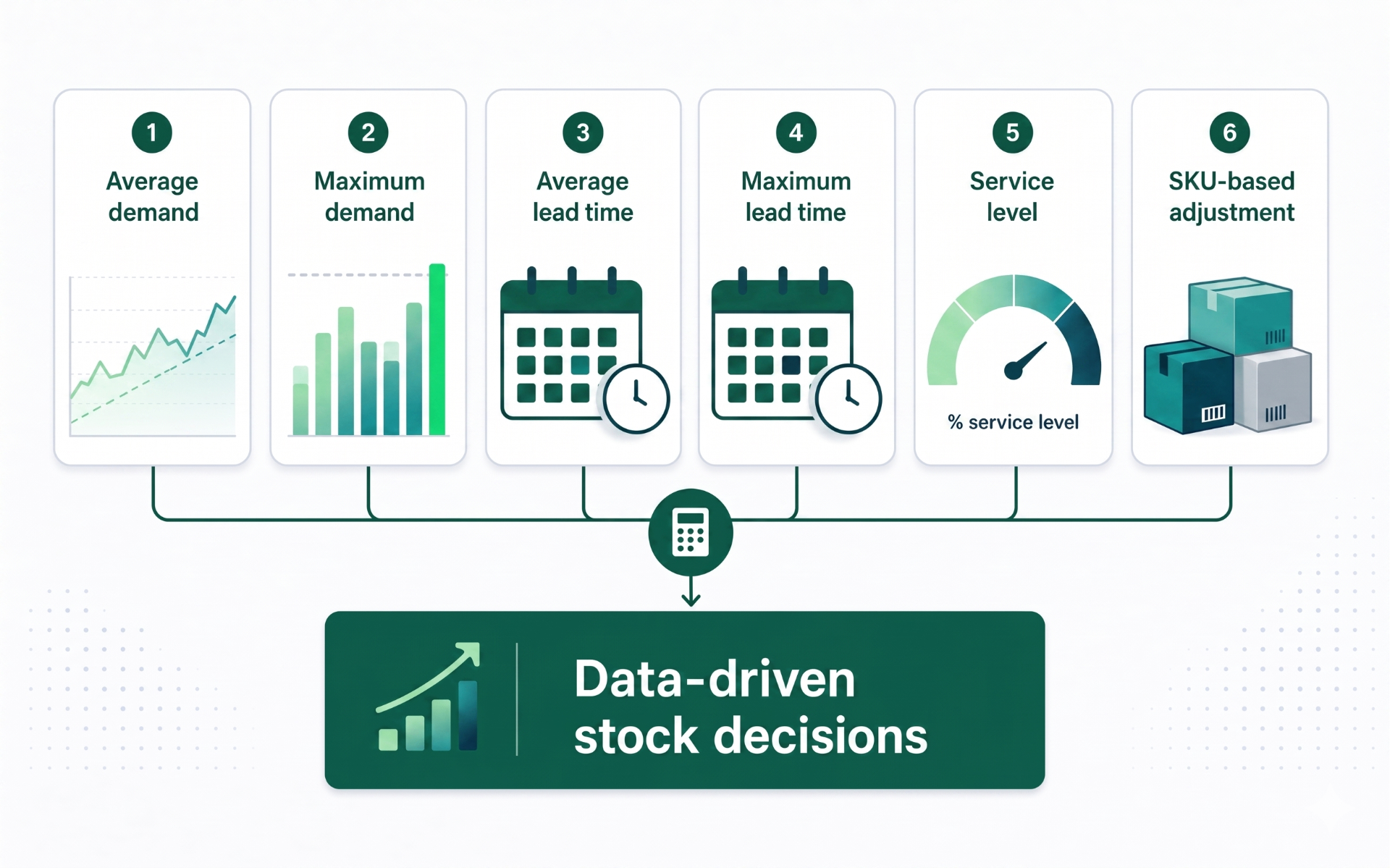
Data you need before calculating it
Before calculating safety stock, you need to know:
| Variable | What it measures | Why it matters |
|---|---|---|
| Average demand | Usual sales or consumption | Serves as the basis of the calculation |
| Maximum demand | Sales or consumption peak | Helps cover stress scenarios |
| Average lead time | Usual delivery time | Indicates how long the supplier normally takes |
| Maximum lead time | Longest recorded or expected time | Measures delay risk |
| Service level | Target availability | Defines how much stockout risk you're willing to accept |
| Demand variability | Changes in consumption | Determines whether you need more or less protection |
| Supplier reliability | Stability in deliveries | Directly affects required stock |
The more variable demand is or the less reliable the supplier, the higher the safety stock tends to be. But more risk doesn't always mean buying more: sometimes it means improving forecasting, renegotiating lead times, changing purchase frequency or reviewing the assortment.
How to calculate safety stock simply
A simple formula to calculate safety stock is:
Safety stock = (Maximum lead time − Average lead time) × Average demand
This formula focuses on lead time variability. For example, if an ecommerce sells an average of 30 units a day, its supplier usually delivers in 7 days and in stress moments takes up to 11 days, the calculation would be:
Safety stock = (11 − 7) × 30 = 120 units
In this case, the company should keep 120 additional units to cover potential supplier delays.
Calculate safety stock with maximum demand and lead time
When both demand and lead time are variable, a more complete formula can be used:
Safety stock = (Maximum demand × Maximum lead time) − (Average demand × Average lead time)
Suppose an average daily demand of 30 units, a maximum demand of 45 units, an average lead time of 7 days and a maximum lead time of 11 days:
Safety stock = (45 × 11) − (30 × 7) = 285 units
The first formula only covers supplier delays. This one covers delays and demand peaks. That's why understanding which risk you are trying to cover is essential.
When you need a more advanced calculation
Simple formulas may be enough for companies with few SKUs, stable demand and reasonably reliable suppliers. But in ecommerce, retail or B2B with many SKUs, they usually fall short.
When there is high variability, seasonality, campaigns, marketplaces, promotions or irregular suppliers, it's worth using models that take into account demand deviation, lead time deviation, service level, margin, turnover and SKU criticality.
In these cases, safety stock cannot be calculated once and left fixed for months. It must be reviewed and adjusted based on business reality.
Common mistakes when calculating safety stock
One of the biggest mistakes in inventory management is applying the same criterion to every SKU. This usually happens when the company works with overly simple rules: 30 days of stock for everything, 10 units of safety per SKU, one month of coverage for each item or buying the same as last month.
These rules look practical but create distortions. High-turnover products need more attention because any deviation quickly becomes a stockout. High-margin products may justify more protection if running out means losing profitable sales. Critical SKUs may need a specific policy even if they are not the best sellers.
Conversely, low-turnover products are dangerous if over-protected. Excess safety stock on slow-moving SKUs can end up as overstock, aggressive discounts, liquidations and lost margin.
How to adjust safety stock without creating overstock
Safety stock stops being useful when it becomes permanent inventory. If a company never touches that stock, it may be over-sized. If it constantly consumes it, it may be under-sized. If it is reviewed only once a year, it is probably outdated.
To avoid this, review safety stock by SKU, adjust calculations based on real demand, take supplier reliability into account and control the cash impact.
The warning signs are clear: frequent stockouts on key products, excess inventory on slow SKUs, recurring urgent purchases, lots of idle stock, low turnover, discounts to free up the warehouse, teams that don't trust the data or decisions based on outdated spreadsheets.
When these signs appear, the problem is rarely an isolated formula. It is usually the decision system itself.
Safety stock in ecommerce and retail: why Excel falls short
Excel can be a useful tool at the beginning. But as the company grows, inventory becomes more complex: more SKUs, more suppliers, more channels, more campaigns, more purchasing constraints, more lead times and more variability.
The problem is not Excel itself. The problem is making critical stock decisions with fragmented information, manual formulas and infrequent reviews. If each team looks at a different spreadsheet, the decision arrives late. And in inventory, deciding late is usually expensive.
A company with physical inventory should not treat safety stock as a fixed number. It should manage it as a dynamic decision policy: which SKUs need more protection, which service level makes sense by category, which suppliers require more buffer and which SKUs do not justify more inventory.
Not every product needs the same protection. Not every risk has the same cost. Not every stockout is equally serious. The key is to prioritize.
How Cymara helps make better stock decisions
Cymara helps companies go beyond basic inventory management to make better stock decisions.
Safety stock is a good example. Calculating it cannot be reduced to applying a formula. It must be a decision connected to demand forecasting, supplier reliability, turnover, margin, purchasing and available cash.
Cymara combines AI software, expert consulting and operational support to help ecommerce, retail and B2B companies with physical inventory regain control over their stock decisions.
This makes it possible to anticipate demand more accurately, adjust safety stock by SKU, reduce stockouts, avoid overstock, improve purchasing decisions, free up trapped cash, protect margin and professionalize replenishment.
The goal is not to hold more inventory. The goal is to hold the right inventory, at the right time, with the least possible capital tied up.
Want to check whether your safety stock is protecting sales or tying up cash? Contact Cymara and we'll help you identify where to adjust inventory, purchasing and replenishment to make better stock decisions.
Frequently asked questions about safety stock
What is safety stock and how is it calculated?
Safety stock is the additional inventory a company keeps to cover unexpected demand or supply delays. It can be calculated with simple formulas, such as:
Safety stock = (Maximum lead time − Average lead time) × Average demand
It can also be calculated with more complete formulas that include maximum demand, maximum lead time, variability and service level.
What is safety stock?
Safety stock is an inventory reserve that protects the company from deviations. It helps prevent stockouts when demand exceeds forecast, suppliers are delayed or replenishment doesn't arrive on time.
What is the difference between minimum stock and safety stock?
Minimum stock is the lowest inventory level a company should maintain to keep operating. Safety stock is an additional quantity kept to cover unexpected events.
Minimum stock marks an operational threshold. Safety stock protects against deviations in demand, suppliers or replenishment.
Why is safety stock created?
Safety stock is created to protect product availability when there is uncertainty. Its function is to cover demand peaks, supplier delays, forecast errors or supply problems.
What does safety stock prevent?
Safety stock prevents stockouts, lost sales, urgent purchases, service issues, operational disruptions and loss of customer trust. When properly calculated, it also improves control over purchasing, inventory and replenishment.