Bill of Materials BOM: What to Include and How to Build It
Cymara ·
A bill of materials, or BOM, is the document that brings together all the components, raw materials, parts, subassemblies and quantities required to manufacture a product. It helps plan purchasing, calculate costs, control inventory and prevent production errors. A well-structured BOM connects design, purchasing, manufacturing and business management.
What Is a Bill of Materials or BOM?
A bill of materials, also known as a BOM, is the complete record of everything a company needs to manufacture, assemble, repair or maintain a product.
It is not just a parts list. A well-built BOM shows which components are needed, in what quantity, with which unit of measure, at which product level they are used and what additional information purchasing, production or engineering teams need to know.
In practice, the bill of materials acts as a single source of information so all departments work with the same data. Without a clear BOM, a company may buy the wrong materials, miscalculate costs, run out of stock or manufacture inconsistent products.
What Is the Bill of Materials BOM of a Product?
The bill of materials BOM of a product is the specific component structure required to manufacture one unit of that finished product.
For example, if a company manufactures an electrical panel, its BOM may include the enclosure, switches, wiring, terminal blocks, labels, screws, packaging and technical documentation. Each item should appear with its quantity, internal code, description and, where relevant, supplier or cost.
In simple products, the BOM may have only a few components. In complex products, it may include several levels, subassemblies and versions. This is common in machinery, electronics, industrial furniture, medical equipment, automotive or any environment where a finished product depends on many interconnected parts.
The key is that the BOM does not only describe what a product contains. It also helps control how it is manufactured, how much it costs, which materials need to be purchased and which changes affect each version.
What a Bill of Materials Is Used For
A bill of materials is useful because it turns product design into operational information. It allows the company to move from "what we want to manufacture" to "what we need to buy, prepare and assemble".
Its main functions are:
- Planning purchasing and procurement
- Calculating the actual or estimated product cost
- Controlling the inventory required for manufacturing
- Preventing stockouts during production
- Reducing assembly or manufacturing errors
- Coordinating engineering, purchasing, warehouse and production teams
- Standardizing the manufacture of repeatable products
- Improving component and version traceability
- Detecting cost or consumption deviations
- Supporting material planning in an ERP or MRP system
When a BOM is up to date, the company can anticipate needs, negotiate better with suppliers and manufacture with less improvisation. When it is incomplete or disorganized, errors usually appear as delays, extra costs, duplications or missing critical materials.
How a Bill of Materials BOM Is Structured
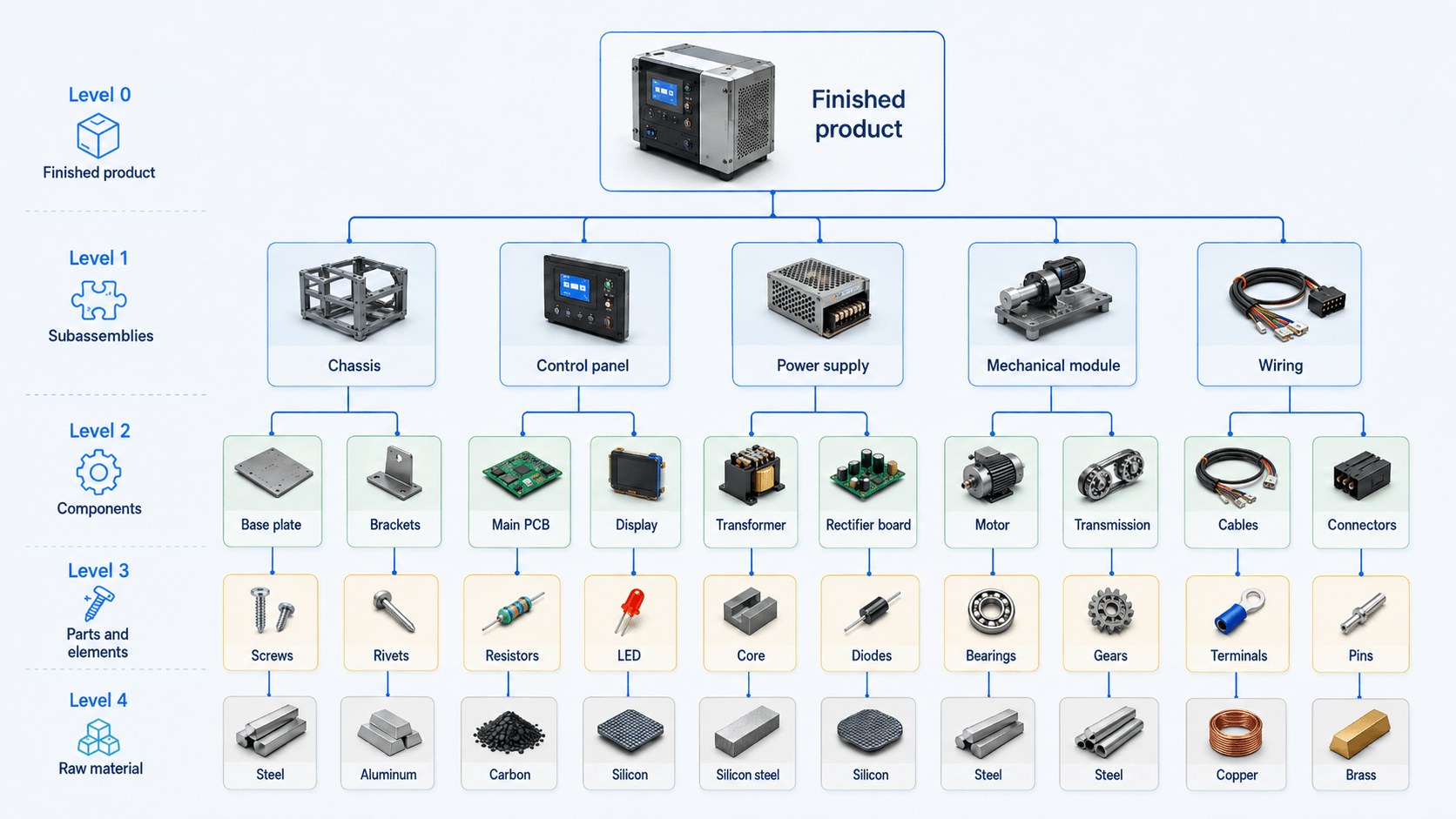
The structure of a bill of materials depends on product complexity, but it is usually organized hierarchically.
The top level corresponds to the finished product. Below it are the main components. If one of those components is made up of other parts, it is broken down into lower levels.
A simple structure would be:
- Finished product
- Main assembly
- Subassembly
- Component
- Raw material
This logic helps understand the parent-child relationship between parts. In other words, which element belongs to another and how each component contributes to the finished product.
In a single-level BOM, only the direct components of the finished product are shown. It is useful for simple products or products with few elements.
In a multi-level BOM, several assembly levels are shown. It is more suitable for complex products because it allows teams to view parts, subassemblies, auxiliary materials and internal relationships.
A good structure should answer three basic questions:
- What is needed to manufacture the product
- How much of each item is needed
- Where each item fits within the finished product
What a Bill of Materials Should Include
A bill of materials should include enough information for purchasing, warehouse, production and engineering teams to work without ambiguity.
The recommended minimum fields are:
- Part code or part number
- Component name
- Clear description of the material or part
- Quantity required per manufactured unit
- Unit of measure
- Level within the BOM
- Type of component or material
- Unit cost
- Estimated total cost
- Main supplier
- Supply lead time
- Component version or revision
- Approval status
- Assembly or usage notes
- Alternative or substitute materials
- Packaging, consumables or auxiliary materials
Not every company needs the same fields from day one. An industrial SME may start with a simpler BOM and expand it as product complexity grows.
The important thing is to avoid incomplete fields, unclear names or duplicated codes. A BOM must be easy to interpret, but also accurate enough to support purchasing, production, costing and inventory processes.
Most Common Types of BOM
There are different types of bill of materials depending on the product life cycle stage, the department using it or the level of detail required.
EBOM or Engineering Bill of Materials
The EBOM reflects the product from the engineering or design perspective. It usually includes parts, components, drawings, technical specifications and revisions associated with product development.
It is especially important when new products are created or when the design changes frequently.
MBOM or Manufacturing Bill of Materials
The MBOM adapts engineering information to the reality of production. It includes the components needed to manufacture, assemble, package or prepare the finished product.
It is the most operational BOM for purchasing, warehouse, production and planning teams.
SBOM or Service Bill of Materials
The SBOM is used for maintenance, repair or after-sales service. It includes repairable components, spare parts and the elements required to service a product that has already been manufactured.
It is useful in machinery, industrial equipment, electronics or products with regular maintenance needs.
Sales BOM
A Sales BOM is used when a product is sold as a set made up of several elements. It helps manage commercial configurations, kits or product bundles.
Single-Level BOM
A single-level BOM shows only the direct components of the finished product. It is easy to read, but may be insufficient when complex subassemblies exist.
Multi-Level BOM
A multi-level BOM breaks the product down into several hierarchical levels. It shows components, subassemblies and raw materials in greater detail.
Configurable BOM
A configurable BOM is used when a product can vary depending on options, versions or customer requirements. It is common in make-to-order manufacturing or customizable products.
Simple Example of a Bill of Materials BOM
Imagine a company manufactures a basic electrical module. Its bill of materials could include:
- Metal enclosure
- Base board
- Main switch
- Internal wiring
- Connection terminal blocks
- Screws
- Identification labels
- Technical manual
- Individual packaging
Each item should have its code, description, quantity, unit of measure, cost, supplier and version. If the internal wiring is made up of several cable types, terminals and connectors, that block can become a subassembly within a multi-level BOM.
This example shows why a BOM should not be limited to listing parts. It should reflect how the product is organized and what information each area needs to manufacture it without errors.
Common Mistakes When Creating a BOM
A bill of materials loses value when its data is not reliable. These are some common mistakes:
- Using generic names for different components
- Not updating versions after an engineering change
- Duplicating part codes
- Omitting packaging, consumables or auxiliary materials
- Mixing units of measure without a clear rule
- Not including updated costs or suppliers
- Managing complex products only with spreadsheets
- Not defining who can modify the BOM
- Not connecting the BOM with inventory, purchasing or production
- Creating a different BOM in each department
To avoid these problems, it is advisable to establish clear coding, review, approval and maintenance rules. The BOM should have an owner, an update process and a real connection with the company's management systems.
Bill of Materials, ERP and MRP
As a company grows, managing bills of materials in spreadsheets can become a risk. Excel may be enough for simple products, but it often falls short when there are many references, versions, suppliers, costs and production orders.
Integrating the BOM into an ERP or MRP system connects the product structure with purchasing, stock, production, costs and material requirements planning. When a production order is created, the system can calculate which materials are needed, what stock is available and which purchases should be launched.
This connection reduces manual errors, improves traceability and supports better decision-making. A well-integrated bill of materials does not only help manufacture products. It also helps control margins, anticipate purchases and maintain a more accurate view of the business.
FAQs About Bills of Materials BOM
What Is a Bill of Materials or BOM?
A bill of materials or BOM is the document that details all components, raw materials, parts and quantities required to manufacture a product. It may also include costs, suppliers, instructions, versions and assembly data.
What Is the Bill of Materials BOM of a Product?
It is the specific structure of materials and components required to manufacture one unit of that product. It may include direct items, subassemblies, raw materials, packaging and technical data associated with each version.
How Is a Bill of Materials BOM Structured?
It is structured hierarchically, with the finished product at the top level and components, subassemblies and raw materials at lower levels. It can also be organized as a single-level or multi-level BOM.
What Are the Types of BOM?
The most common types are EBOM, MBOM, SBOM, Sales BOM, single-level BOM, multi-level BOM and configurable BOM. Each one responds to a different need within engineering, manufacturing, sales or service.
What Should a Bill of Materials Include?
It should include part code, name, description, quantity, unit of measure, level, cost, supplier, lead time, version, approval status and relevant manufacturing or assembly notes.